



Investors can be forgiven if they see cause for concern in return forecasts these days, and if they feel less than confident about meeting their objectives. That anxiety can be fed by an expected increase in volatility – and it can be argued we’ve already reached a significant inflection point in that regard – that leaves investors facing the prospect of de-risking their portfolios using rather dated approaches.
“There are a lot of things pushing volatility,” says the CIO of a U.S. state teacher retirement fund. “We have great fundamentals, but things are starting to shake a little bit, and we are more concerned about it than we’d like to be – and we think that volatility is likely to go up. We built volatility into our strategy at a normal or mean level, and right now we’re on the higher end of normal.”
The State of Play
When investors look to the horizon today and anticipate increased uncertainty, they see numerous sources of major risk, including:
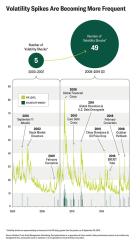
- More frequent volatility spikes: In the eight years prior to the 2008-2009 global financial crisis, a one day move of five points or more on the VIX occurred only five times. Post-crisis, such a spike has occurred 48 times – with “spike” being the key word as it relates to return distribution.
- An inconsistent business cycle: The U.S. business cycle has been seesawing between expansion and slowdown, and for the first time since the crisis, the leading economic indicators are flashing yellow, according to the Leading Economic Index.
- International trade conflict: Global trade tensions, and their knock-on effects of global supply chain recalibration and redistribution, have rocked global growth numbers. The U.S.-China dispute will likely take years to resolve. The “one world, two systems” model – capitalism on one side, statism on the other – will be detrimental to growth and additive to volatility.
- Uncertain central bank policies: Technology has a massive deflationary effect, which consumers love but central banks not so much because it eliminates their monetary policy target. Most central banks target inflation. If they can’t stimulate inflation to the appropriate level, how do they remain relevant? What is that new policy model behind their actions? “There currently exists no macroeconomic theory that is consistent with today’s data,” says Michael Hunstad, Ph.D., Head of Quantitative Strategies at Northern Trust Asset Management. “If we don’t know what to do from a monetary policy perspective, it has implications for volatility.”
- More volatility selling: The microstructure of the market has changed materially, and thanks to algorithmic trading, volatility selling has become more popular since the global financial crisis, and that has contributed to more downside volatility, with much more likely to come.
The 3 Major Sources of Volatility on the Horizon