

Where the Alpha Is
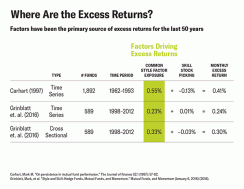
From a historical perspective, it has been demonstrated that style factors deliver superior risk-adjusted returns compared to passive market cap-weighted indexes, and that they offer more persistent performance compared to traditional active management. As such, style factors are a compelling option for investors looking to de-risk their portfolios – which can be a bit of a surprise for some investors who think of de-risking as a defensive posture.
But that view isn’t common among all investors.
“About 25% of our equity allocation is in factors,” says the portfolio manager for public equities at a U.S. state retirement system. “The reason why we split it 75-25 initially is because our analysis showed that it improves the Sharpe ratio. We started off with a quarter of the equity allocation, and we wanted to see how it does over time because it’s a long-term strategy where after three to five years we should be able to harvest some risk premia. If that’s the case we may increase it, maybe up to 50%. It depends on what our findings are. We’ll do another assessment at that time. The point was to dip our toe into it and see if we should increase or reduce it over time. During implementation the main challenge was a lot of churn when we traded for the quarterly rebalance.”
What’s behind style factor return premia? Explanations and interpretations vary, but tend to fall into one of three categories:

- Risk-based explanations imply that volatility alone is not enough to describe risk, and measures such as the Sharpe ratio do not truly represent risk-adjusted performance – i.e. style factor investors earn a premium because they are actually bearing more risk.
- Structural explanations assert there are constraints that prevent CAPM assumptions from holding. The most common of these explanations is that if investors are unable to use leverage, but have high return requirements, they have tended to focus on high beta assets to create internal leverage. This creates inefficiencies as high beta assets become mispriced relative to the market.
- Behavioral explanations suggest that investors are prone to persistent behavioral biases that ultimately manifest as factor anomalies such as representative bias and asymmetric risk preferences.
Learn why the quest to capture efficient alpha requires a challenge to modern portfolio theory.
Advanced portfolio design and implementation
Style factors are susceptible to cyclicality and expose investors to the risk of sustained underperformance – but style factor cyclicality can be mitigated by employing multi-dimensional factor definitions and diversifying across factors on top of other methods of reducing risk without sacrificing returns.
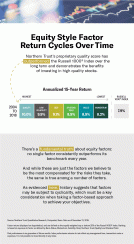
The key to the mitigation of cyclicality in the use of style factors is intelligent design and implementation, which accommodate less severe drawdowns, which in turn may encourage investors to stay the course during the ebbs and flows of volatility.
The chart below helps illustrate how a factor approach might help solve the dual challenges of de-risking while meeting return expectations.
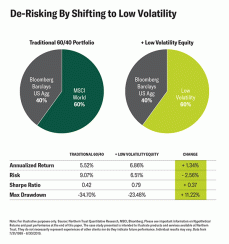
Using a simple 60/40 portfolio and starting with a passive allocation beginning in 1999, notice that the portfolio has returned 5.5% at a 9% realized risk. That performance can safely be called underwhelming for the relevant time horizon – and it suffered a nearly 35% drawdown during the financial crisis in 2008. This is a time period where stocks and bonds have similar realized returns and, stocks had significantly higher realized volatility. (For the purposes of this example, a 60/40 blended benchmark refers to the Asset Allocation Blend Index, consisting of 60% MSCI All Country World Index and 40% Bloomberg Barclays U.S. Aggregate Bond Index. It is not possible to invest directly in an index.)
Now, look at an allocation that uses a low-volatility factor for its equity allocation rather than the market cap-weighted index. It has lower risk than the benchmark, making it a potentially ideal candidate for investors looking to de-risk, provided it improves risk-adjusted returns from a risk reduction standpoint and from an improvement in the numerator.
The current and anticipated return environment as described earlier in the report is one that has been very conducive to low-volatility factor performance. The scenario above shows unambiguous improvement on several important measures to investors – a return improvement of 134 basis points, from 5.52 to 6.86%; a realized reduction in risk of 2.56% – a 28% reduction, from 9.07% all the way down to 6.51%; a nearly doubling of the Sharpe ratio from 0.42 to 0.79, and, importantly, that is counting the numerator and the denominator.
Finally, during the steep market equity market drawdowns in 2008 a market cap-weighted index, by definition, experienced 100% of that drawdown. In the traditional 60/40 context that led to a nearly 35% drawdown. A hypothetical low-volatility factors portfolio in that same scenario improved the drawdown by a little over 11%.
“If you look at the full body of research available, regardless of asset class or geography, and across all aspects of the market capitalization spectrum, it points to the resounding conclusion that lower volatility securities, in general, tend to come with higher returns – especially in markets that are punctuated by volatility spikes,” Michael Hunstad, Ph.D., Head of Quantitative Strategies at Northern Trust Asset Management.