

No two institutions have the exact same needs, nor does any one institution have unaltering challenges. In short, things change, and investors want to know they can customize strategies to meet their current requirements, and that they have the flexibility to meet future challenges as they evolve.
Prior to the widespread adoption of ETFs, liquidity strategies were typically constructed using cash or other liquid asset classes that could have non-trivial tracking error to policy benchmarks. While this approach may still be sufficient for some investors, it may result in unintended overweights or underweights relative to their benchmark or policy statement.
To that end, BlackRock has engaged with clients that seek more tailored liquidity allocations to reflect their full investment policies, subcomponents of the allocation on the public or private side, or other portfolios – and to seek to avoid unintended consequences of investment strategy decisions.
Precision liquidity management and factors
Among the many new and innovative uses of ETFs that have accompanied their growth and development is increasingly precise liquidity management. This is possible thanks to the growing number of sizeable and sufficiently liquid ETFs in multiple asset classes. Transacting in ETFs may offer a reduction in implementation time and transaction costs relative to individually trading in the underlying assets.
When a tailored portfolio is under construction, various tradeoffs are considered to help determine an efficient fit for an investor, including active risk to policy benchmark, trading cost, management fees, and liquidity of the ETFs.
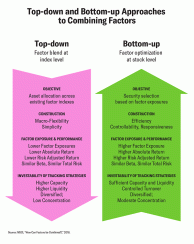

Factor-weighted exposures have been increasingly important in numerous customized liquidity solutions. The solutions utilize either the bottom-up or the top-down factor investing approach. Each approach has a distinct effect worth consideration by investors.
Making allocations to individual factors typically requires strong investment beliefs, as factor returns have been cyclical in nature. In one study, MSCI used a bottom-up approach to build a multifactor index from stocks that are favorably exposed to the value, size, quality and momentum factors, and compared it to an alternative top-down approach combining single factor indexes. The two approaches were compared in terms of their level of exposure to the target factors as well as their capacity and investability profiles.
MSCI’s analysis, which included hypothetical back-tested performance, showed that both approaches would have demonstrated outperformance versus a market cap-weighted parent index during the study period. In the context of multi-factor index construction, the top-down allocation offered the advantages of simplicity, relatively higher capacity, and lower active risk. However, the exposure to the target factors was muted due to a dilution effect caused in part by offsetting stock weights across the single factor portfolios.
On the other hand, the bottom-up approach, which used optimization, did not have this same dilution effect. Instead, it showed higher and more persistent overall exposure to the target factors. As a result, both risk and return were attributed more to the target factors as desired. However, the level of active risk may be higher in the bottom-up approach and relative capacity may be lower. The choice between these approaches may depend most on the particular needs of the institutional investor.