
Portfolio de-risking has many faces, but what matters most is which one your portfolio sees when it looks in the mirror. For the sake of clarity, investors can think of them in the standard parlance of evolving technology starting at 1.0, starting from what today would be considered a typical baseline institutional portfolio of stocks, bonds, and alternatives.
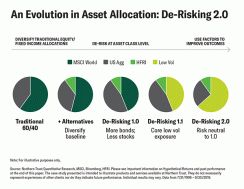
- De-Risking 1.0 reallocates more to bonds, less to stocks, and in general lower-risk asset classes.
- De-Risking 1.1 replaces the existing equity allocation with core low volatility exposure.
- De-Risking 2.0 increases the allocation to low-volatility while staying risk neutral to De-Risking 1.0.
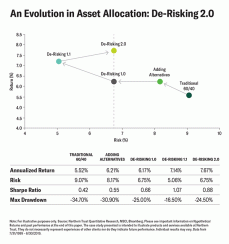
Focusing on De-Risking 1.0 and De-Risking 2.0, assume that the investor is comfortable with a realized risk of 6.75%. What might the investor get for a similar risk budget in De-Risking 2.0, using low-volatility equities as the equity allocation at the core versus a cap-weighted MSCI World allocation? Significant improvement. The risk remains the same, the return increases by about 1.5%, to 7.67% from 6.17%. The Sharpe ratio improves by 0.22, and the maximum drawdown stays about the same. But the investor achieved all this with a greater allocation to equities than is present in De-Risking 1.0. Not a bad outcome when the max drawdown is the same.
“If we put our assumptions about forward returns into De-Risking 1.0, we’re looking at similar performance to what we’ve seen since 1999 using De-Risking 1.0, or perhaps even lesser performance given where yields are at today,” says Michael Hunstad, Ph.D., Head of Quantitative Strategies at Northern Trust Asset Management.
“That’s the classic knee-jerk reaction to de-risking,” he continues, referencing the move to include more bonds. “But it’s not uncommon. Investors are very cautious about that given where Treasury and bond yields are in the U.S. and globally.”

Is there potential for investors to realize even greater excess return in a de-risked portfolio that mitigates for the possibility of a down market? There just might be. Think of it as De-Risking 2.1, and it adds quality factors to low-volatility factors.
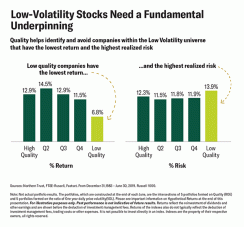
Comparing two de-risking portfolios – one low-volatility only, the other a combination of low-volatility and quality factors – it’s apparent adding quality to a low-volatility portfolio helps to the tune of a 2% improvement in the top decile, and some improvement in the second decile.
“Volatility measurement is almost exclusively price-based,” adds Hunstad. “By adding a quality dimension, you have more of a view of the financial picture of a company, in addition to that price-based factor. When you meld those ideas – low price volatility, good profitability, cash flow, balance sheet, and so on – that tends to be your best bet.”
And, quite possibly, a major step toward closing the anticipated return gap investors are projected to face over the next five years.
Disclosures
Important Information
The information contained herein is intended for use with current or prospective clients of Northern Trust Investments, Inc. The information is not intended for distribution or use by any person in any jurisdiction where such distribution would be contrary to local law or regulation. Northern Trust and its affiliates may have positions in and may effect transactions in the markets, contracts and related investments different than described in this information. This information is obtained from sources believed to be reliable, and its accuracy and completeness are not guaranteed. Information does not constitute a recommendation of any investment strategy, is not intended as investment advice and does not take into account all the circumstances of each investor. Opinions and forecasts discussed are those of the author, do not necessarily reflect the views of Northern Trust and are subject to change without notice.
This report is provided for informational purposes only and is not intended to be, and should not be construed as, an offer, solicitation or recommendation with respect to any transaction and should not be treated as legal advice, investment advice or tax advice. Recipients should not rely upon this information as a substitute for obtaining specific legal or tax advice from their own professional legal or tax advisors. References to specific securities and their issuers are for illustrative purposes only and are not intended and should not be interpreted as recommendations to purchase or sell such securities. Indices and trademarks are the property of their respective owners. Information is subject to change based on market or other conditions.
All securities investing and trading activities risk the loss of capital. Each portfolio is subject to substantial risks including market risks, strategy risks, adviser risk and risks with respect to its investment in other structures. There can be no assurance that any portfolio investment objectives will be achieved, or that any investment will achieve profits or avoid incurring substantial losses. No investment strategy or risk management technique can guarantee returns or eliminate risk in any market environment. Risk controls and models do not promise any level of performance or guarantee against loss of principal. Any discussion of risk management is intended to describe Northern Trust’s efforts to monitor and manage risk but does not imply low risk.
Past performance is no guarantee of future results. Performance returns and the principal value of an investment will fluctuate. Performance returns contained herein are subject to revision by Northern Trust. Comparative indices shown are provided as an indication of the performance of a particular segment of the capital markets and/or alternative strategies in general. Index performance returns do not reflect any management fees, transaction costs or expenses. It is not possible to invest directly in any index. Net performance returns are reduced by investment management fees and other expenses relating to the management of the account. Gross performance returns contained herein include reinvestment of dividends and other earnings, transaction costs, and all fees and expenses other than investment management fees, unless indicated otherwise. For additional information on fees, please refer to Part 2a of the Form ADV or consult a Northern Trust representative.
Forward-looking statements and assumptions are Northern Trust’s current estimates or expectations of future events or future results based upon proprietary research and should not be construed as an estimate or promise of results that a portfolio may achieve. Actual results could differ materially from the results indicated by this information.
If presented, hypothetical portfolio information provided does not represent results of an actual investment portfolio but reflects representative historical performance of the strategies, funds or accounts listed herein, which were selected with the benefit of hindsight. Hypothetical performance results do not reflect actual trading. No representation is being made that any portfolio will achieve a performance record similar to that shown. A hypothetical investment does not necessarily take into account the fees, risks, economic or market factors/conditions an investor might experience in actual trading. Hypothetical results may have under- or over- compensation for the impact, if any, of certain market factors such as lack of liquidity, economic or market factors/conditions. The investment returns of other clients may differ materially from the portfolio portrayed. There are numerous other factors related to the markets in general or to the implementation of any specific program that cannot be fully accounted for in the preparation of hypothetical performance results. The information is confidential and may not be duplicated in any form or disseminated without the prior consent of Northern Trust.
© 2019 Northern Trust Corporation. Head Office: 50 South La Salle Street, Chicago, Illinois 60603 U.S.A. Incorporated with limited liability in the U.S. Products and services provided by subsidiaries of Northern Trust Corporation may vary in different markets and are offered in accordance with local regulation. This material is directed to professional clients only and is not intended for retail clients. For Asia-Pacific markets, it is directed to expert, institutional, professional and wholesale investors only and should not be relied upon by retail clients or investors. For legal and regulatory information about our offices and legal entities, visitnortherntrust.com/disclosures.
Northern Trust Asset Management is composed of Northern Trust Investments, Inc. Northern Trust Global Investments Limited, Northern Trust Fund Managers (Ireland) Limited, Northern Trust Global Investments Japan, K.K, NT Global Advisors Inc., 50 South Capital Advisors, LLC and investment personnel of The Northern Trust Company of Hong Kong Limited, and The Northern Trust Company.