

Investors who rely on a black and white, risk-on or risk-off view to determine how they might adjust their strategies could be in for a bumpy ride if the expected increase in volatility includes more frequent peaks and troughs. It could be argued that more sophisticated investment strategies have rendered the choice between being either risk on or risk off obsolete. When one strategy can provide solutions for both up- and down-market scenarios, and potentially provide much needed alpha to help close an anticipated returns gap, why rely on constant rejiggering and worry about timing?
For institutional investors, it’s an interesting prospect to consider – a plan, endowment, or foundation needs its money when it needs it, regardless of what the markets can provide in a given moment or trend period.
“If the equity return expectation is only 5.8%, this contractionary environment may indeed be conducive to a different approach within an investor’s equity bucket,” says Michael Hunstad, Ph.D., Head of Quantitative Strategies at Northern Trust Asset Management.
Although the equity sleeves of most investors today contain a significant amount of passive investments, asset allocators seem most likely to look for a fresh approach – and alpha – by teaming with active managers.
“Passive is good in the beginning of a cycle, but as valuations are stretched, it’s time for more active management,” says the CIO of a U.S. state teachers’ retirement fund.
“We’re not trying to time the cycle,” says the Head of Equities at a European pension fund. “Equity valuations are high, there’s more volatility creeping in. The best part of the equity run is over. There’s more volatility and not the return we’ve seen over the past few years.”

This investor says his portfolio is “roughly a third active and two-thirds passive,” and that the active portion is focused on active quantitative strategies and impact investments. “It’s a combination of active and quant strategies. The active quant is a fixed allocation, and we believe a factor portfolio can help to reduce volatility and generate returns. So, we expect our managers to be able to build equity portfolios based on factors.”
A “Different” Approach
The “different” approach Hunstad mentions is based on simultaneously strengthening and de-risking a core equity portfolio so investors gain exposure to compensated risks within the equity market, and, through the use of style factors, understanding the excess return potential in different economic environments.
For example, says Hunstad, “We have just come through a slowdown. In a slowdown, low-volatility stocks tend to do reasonably well, along with high momentum and higher quality stocks. We saw this pattern play out over the last several months and years. In contrast, size, value, and high-dividend yield tended to be relatively lackluster, even having negative performance. In a contractionary environment, however, low volatility exhibits dominant alpha above the cap-weighted benchmark.”
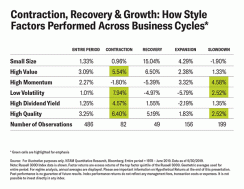
Hunstad and his team believe that opportunities to outperform exist if you know where to find them, and that such opportunities aren’t contingent on a traditional “risk-off” execution. That said, active strategies in general vary widely, and how they are utilized by investors is very relevant to the holistic performance an investor might achieve.
“Over the years, we’ve analyzed many equity allocations from our clients, and while they have evolved, use of the so-called style box is still prominent,” says Jordan Dekhayser, Head of Quantitative Equity Research and Strategy, Northern Trust Asset Management. “While it’s certainly true that individual managers can and do add value, investors need to closely consider their overall portfolio in aggregate. Certain portfolio constructions can prevent the opportunity to provide enough active risk – or, in other words, enough potential to outperform the market – than an investor would need to close a 2-3% anticipated return gap. Even if you have individual managers that have a lot of active risk, when you put them all together they tend to plot very close to the benchmark, and holistically there’s not a lot of active risk.”
If diversification of managers doesn’t necessarily lead to true diversification in portfolios, overdiversification of managers is a risk in itself when active management fees eat into alpha. Faced with a choice of a mix of passive (beta), fundamental active, and factors strategies, many investors are aware of data that shows fundamental active management hasn’t necessarily provided the jolt to returns for which they’ve hoped.