

Investing in emerging market equities comes with its share of complexity. For example, if you’re canvassing the world for data, relevant financial statements for investable companies come in a multitude of languages. The challenges, however, are not insurmountable, and the opportunities certainly merit the work involved.

“It’s commonly asked if we get ripped up doing emerging markets trading every day,” says Arup Datta, Head of Global Quantitative Equity at Mackenzie Investments. His response, based on nearly 28 years of quantitative investing experience, is “Absolutely not. It’s to our advantage that we’re built to trade every day.”
In that context, Datta is referencing the holistic integration of stock selection, portfolio construction, and trade execution at the firm.
Bottom-up stock selection plays to the strength of quantitative strategies, and for Datta and his colleagues that means a focus on a core approach.
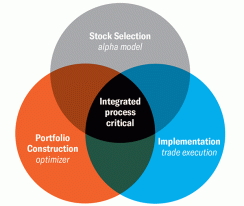
“Our team’s edge is a steadfast belief in the adherence to a core focus which aims to produce a more consistent alpha profile through multiple market environments,” says Sean Furey, Investment Director, Mackenzie Global Quantitative Equity Team. “They place great importance on daily stock analysis, proprietary transaction cost estimation, and capacity management. A quantitative lens – aided by computing power, sophisticated algorithms, and adaptive models – provides the team with a measurable process to value securities.”

Focus has helped in challenging times
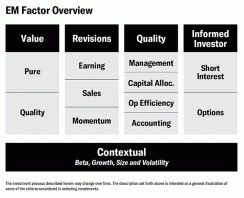
The focus on core strategy has helped the team at Mackenzie Investments weather what has been a bit of a bumpy ride for quants over a several year period. Each stock is adjudicated against 15-20 factors which are broadly grouped into four “super factors”: Value, Quality, Revisions, and Informed Investor. A balanced weight is assigned to the super factors at the portfolio level. Weights vary by individual stock. For example, within Value, the team divides the weight between what it calls Quality Value, such as cash flow-based valuations, and Pure Value, which includes earnings-based valuations. The Quality factor balances management actions, such as capital allocation and operating efficiency. The Revisions factor mainly refers to analyst revisions to forecasts, while the Informed Investor factor analyzes investor activity, such as short interest and option pricing.
“We’ve observed that active quant managers have generally struggled for a few years, but in 2019 we ended up with encouraging performance across our strategies,” says Datta. “When you have enough of value, growth, and quality in your process – and most market environments belong to one of those three categories – you’re not as exposed as the investment environment shifts,” Datta says.
An ongoing debate among quantitative investment professionals is the use of “new” factors versus “old” factors. It’s not a question Datta ignores, but he does think it’s readily addressed by keeping an open mind. “We have a good balance between value, growth, and quality, but we are always looking at how to improve. For example, lately we have focused effort on what is referred to as vague or alternative data – transcripts, financial statements, text parsing, natural language processing, and the like. That’s a way we’ve been successfully blending the new and the old. We will always have things like cashflow-based valuation, i.e. if a name is looking cheap relative to its peers, and other traditional factors. At the same time, we have quite a few new/alternative factors being added to the mix, including in emerging markets. The goal is always to hopefully add value in a variety of environments.”
Human intelligence overlay
The emerging markets investment capacity at Mackenzie is, at a high level, constrained, so that the team can be in and out of stock ahead of managers encumbered by much larger AUM. Leveraging its computing power, the team is as nimble as they come, ranking and trading stocks daily, tapping into highly ranked names it doesn’t currently own and getting out of names that have fallen down the ranking.
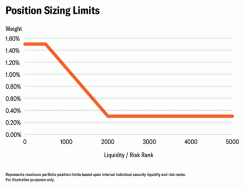
Daily trading and daily rebalancing require a strong infrastructure, especially with a 24/6 clock (Middle East markets are open on Sunday). Mackenzie’s EM team spends a lot of time making sure that its models can run several times over the course of a day – as Asia opens and closes, then Europe, and finally the U.S.
“The world never stops for anyone in terms of the rebalancing cycle, so when other managers say they rebalance monthly or weekly, that’s a lot of missed opportunity, and it’s why we scrape data daily and rank stocks daily. There is always new information out there, and a name might still look cheap in a week or two, but I’d rather buy today than five days later when the stock has run up a lot already,” says Datta.
A common knock against quant strategies is that they are “black box,” meaning they lack transparency and turn over all decisions to computers. Embedded in the process at Mackenzie Investments, however, is a feature that not many other quantitative shops offer – serious and detailed human review. If there is one thing Datta makes clear he abhors it’s the “garbage in, garbage out” results of unchecked data dumping.
“It’s even more an issue in emerging markets because the data is dirtier there,” says Datta. “Most quants claim they do some statistical checks, but every trade we do is vetted or checked by either myself or my colleagues in the portfolio management and research teams at Mackenzie. And we do find names that we pull on an almost daily basis. We don’t trade them because we found that some variable the model was looking at was not correct, or that various data sources didn’t agree. Why are we selling a name? Why did we buy this for the first time? We dig deeper. If the data is bad you’re making a wrong investment decision, so we do spend time making sure the data is clean on a name-by-name basis in our buys and sells. Pulling trades is something we do almost every day, and certainly more prevalent in our emerging markets strategies than it is in our developed market strategies.”
All of this requires top-level talent, and Datta builds his team based on their programming excellence, and with an eye consistently on the future. “One trait of our quant business is that we mix the experienced people like me with the tech-savvy youth, not all of whom need to be PhDs. There are plenty of smart people with undergrad and masters’ degrees out there. The importance of mixing experience and bright, new thinking is that technology changes at a very fast pace, and it will change even faster going forward. Today, everyone uses [the programming language] Python. That was not the case five years ago, and I don’t know what the new Python will be five years from now, but I can tell you it won’t be Python. It will be something else.”
The human factor extends to EM trade execution as well, where varied exchanges, trade settlement processes, and so forth come into play.
“We have as much sophistication and discipline in our execution as we do in our stock picking and risk management – it’s all integrated into a single process,” says Datta.
The firm has proprietary market impact/trade cost models for every trade, with key drivers such as the level of liquidity demanded and stock volatility. According to Datta, its actual EM transaction costs have always come in slightly below what has been anticipated – a clear sign that trade execution is solid. “We deal with many brokers, and we are upfront in telling them that we trade a lot of names every day and we try to get the lowest commission possible because of the volume business we do,” says Datta. “And we let them know they’ll be measured versus yesterday’s closing price and VWAP [volume-weighted average price]. We monitor them closely, and if a broker is not doing well, we cut them off or lower the trading with them. It’s a very efficient process.”
Strong execution is particularly relevant when shorting an emerging markets’ stock, which is something that sophisticated investors sometimes avoid. It can be done through swaps, but execution is crucial when shorting in different regions of the world. “For example, there are plenty of hedge funds out there that appear to be shorting in Asia and China, but if you dig deep most of them have a long bias and all they’re shorting is the benchmark,” says Datta. “With the market-neutral type product such as we have in emerging markets, we actually short single stocks in almost all emerging markets.”
Learn more about how quant strategies can unlock potential in emerging markets.